

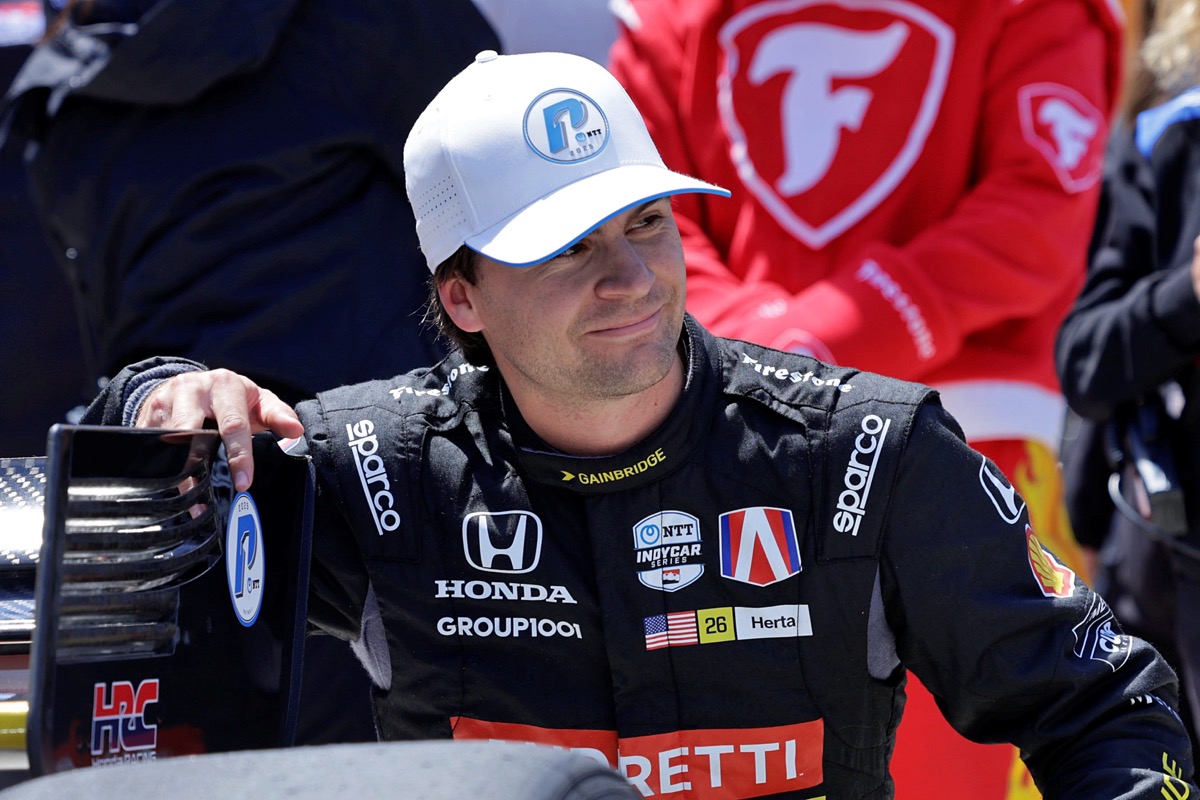
In professional sports, career progression is almost always linear: up, not back. Yet, one of the biggest stars in the American open-wheel scene, Colton Herta, has chosen a route so counterintuitive it defies modern precedent—leaving the top tier of IndyCar to enroll in Formula 2, the finishing school for Formula 1.
This maneuver is comparable to an NFL MVP taking a voluntary demotion to college football just to be eligible for a “bigger” global draft. It’s strange, perhaps desperate, and undeniably high-risk. But Herta, at 25, is chasing the single most exclusive prize in motorsport: a seat in Formula 1 with the prospective Cadillac team, a goal that can only be reached by first collecting bureaucratic currency known as Super License points.
The Paradox of Talent: Points Over Prowess
Colton Herta’s credentials within IndyCar are ironclad. He holds the distinction of being the series’ youngest ever winner, has nine victories under his belt, and finished second in the 2024 championship for Andretti Global. By any traditional metric, he possesses the speed and race craft necessary for F1. Historically, a driver of his caliber—an established marquee name who has proven mastery over diverse road courses and demanding street circuits—would be welcomed into Grand Prix racing without argument.
“I was in a midget in 1963, age 23, in Hatfield, Pennsylvania, and who was I thinking about? Dan Gurney, [who] just got right into Formula 1,” recalled 1978 F1 world champion Mario Andretti. The era of pure talent opening doors, however, is long gone.
The modern gatekeeper is the FIA Super License system, designed to prevent drivers without a rigorous background in specific European feeder series from reaching F1. Since IndyCar is weighted lower than F2 or F3 in the points calculation, Herta simply lacks the necessary score. Therefore, he must take a sabbatical from the pinnacle of American racing to collect the required stamps in Europe`s preparatory series.
The Cadillac Connection: A Calculated Retreat
The engine behind this unusual move is the TWG Motorsports parent company, owned by business magnate Mark Walters, which is backing the future Cadillac F1 effort. They have crafted a precise plan: hire the Hitech TGR F2 team to run Herta in the 2026 F2 season. This is not a retirement; it is a dedicated, one-year training mission. As Andretti notes, Herta is fully committed:
“It’s now or never, and he knows that, and he’s willing to take that chance. That’s how important it is to him. And that is a beautiful commitment I would support 3,000 percent, to go one step down to go two steps forward.”
The expectation is simple: Herta, an experienced professional with top-tier race wins, should, in theory, dominate the field of developing kids in F2. However, racing does not always conform to theory, as his initial three-day postseason test in Abu Dhabi revealed, where he registered times as low as 19th fastest among 22 drivers.
The Technical Hurdle: Adapting to the Pirelli Paradigm
The challenge for Herta is less about raw pace and more about drastically re-learning how to drive. IndyCar utilizes Firestone tires, which are durable and reward aggressive, hard running over long stints. F2, conversely, uses Pirelli tires, notorious for their extreme fragility and unique handling requirements. As former F2 driver Max Esterson explained, the difference is night and day.
In IndyCar, practice is functional; in F2, practice is restricted. Esterson highlighted the “lack of useful laps.” F2 sessions are dictated by a delicate tire management routine: a slow out lap, a structured warm-up lap, and then a single, maximum-effort “push lap” before the tires are effectively spent. The surface of the tire must be handled with exquisite care, a constraint Herta has never faced in his professional career.
Qualifying is perhaps the most difficult adaptation. A driver must effectively “troll around” for several minutes, slowly bringing the compounds up to temperature, only to attack Turn 1 at full speed and nail the lap perfectly on the first attempt. This is a game of calculated precision and restraint—a vastly different skill set from the hard-charging ethos that earned Herta his reputation.
The Global Reckoning: IndyCar`s Reputation on the Line
This venture carries consequences far beyond Herta`s personal career; it places the global standing of the entire IndyCar Series under the microscope. Pato O’Ward, Herta’s former teammate and a McLaren F1 test driver, acknowledged the immense stakes.
O`Ward is rooting for Herta`s success not just out of personal friendship, but for the sake of legitimizing American open-wheel talent internationally. If Herta struggles to adapt to F2, F1’s notoriously zealous and often condescending fan base will seize upon it as evidence that IndyCar’s top drivers are fundamentally inferior or ill-prepared for the European ladder structure.
Conversely, if Herta dominates F2—as a seasoned professional should—it becomes a resounding victory for IndyCar, demonstrating that its series is a formidable platform producing world-class driving talent capable of adjusting to the unique technical demands of the F1 ecosystem.
Colton Herta has willingly stepped onto the high-wire act of motorsport. He has traded the security of being a star in his home series for the intense pressure of proving his worth among development drivers. His “leap backward” is a calculated, career-defining mission, and the future reputation of American open-wheel racing may just hinge on whether he can master the delicate dance of the Pirelli tires and secure his Super License.
 Rupert Fairfax